
Every two years a small army of amazing volunteers comes together to showcase the beautiful village of Beckford, a quiet rural village at the southern foothills of Bredon Hill with a long history of settlement stretching back to the 8th century. If you enjoyed this year’s Open Village, make a note of the Next One – June 3rd and 4th 2028.
The theme for this year’s event was “Pollinators“, with some special attractions to illustrate the theme – an essential ingredient for super gardens. Many plants, including the beautiful flowers we like to surround ourselves with, rely on pollination for survival. Flowers abound in spring and summer. Their generous offering of colour, smell and nectar are all on show for one reason – to seduce a pollinator to pay them a visit. Plants provide sweet nectar and pollen for pollinators. In return, pollinators move pollen from one flower to another. Their services are essential for plants, including the ones we like to eat, as without pollination they cannot make the seeds, fruit and nuts needed to grow seedlings and spread to new areas.
The list of insect pollinators is long and, although honeybees get most of the credit, at least 1,500 insect species pollinate plants in the UK. This includes many different species of bees, flies, wasps, beetles, butterflies and moths. Even species with a bad reputation such as houseflies and mosquitoes are important pollinators. In some parts of the world, birds, bats and even lizards also get involved!
For some plants, the process of pollination is the work of the wind and rain. In other cases, flowers just pollinate themselves. But many species have evolved to get insects and other animals to do the work for them.
For an animal to be an effective pollinator it needs to actively visit flowers of the same species and be capable of carrying pollen on its body (often unintentionally) so that it transfers from one flower to another. See them busy at work as you enjoy the gardens!
This year’s event was enjoyed by well over 1000 visitors, making it a great success. Despite the ‘not-so-good’ weather – rainy and cold on Saturday and brighter on Sunday – some of the attractions became more popular. The Bell Towers were very popular this year and although the weather prevented the spitfire flypast on Saturday, we were able to enjoy this special attraction on Sunday with a Mark 4 Spitfire treating us to two swoops over Main Street.
If you enjoyed the Open village on one or both of the two days and you took lots of photos, don’t forget to enter your best efforts into our photo competition – click here to send us your images and win a prize. All entries will be displayed on the Photo Competition page
Beckford History
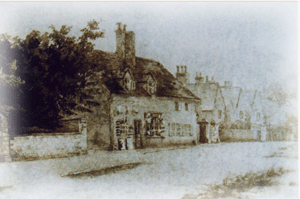 The name Beckford derives from “Becca’s ford”, a crossing point over the Carrant Brook which runs along the south side of the village. The earliest known settlement was to the east of the current village around 50 A.D. Items of 2nd and 3rd century pottery have been discovered around the village and just to the west, a cemetery dating largely from the 6th century, containing at least 107 graves.
By the late 8th century there was a minster church at Beckford. In 1086 there were 69 inhabitants living in Beckford and by 1662 there were 26 houses assessed for tax (of which 5 still survive). The Main Street is probably ancient and the chief houses, Beckford Hall (Nos.5 and 6), the Court House (No.12), and the Vicarage, stand on the north side of the street close to the church. The Old House (No.7) from the c.16th century stands at the east end of the village.
Near the entrance to the churchyard the street widened out to form a small square where, in the early 19th century, stood a slate-roofed cross. This square, then called the market-place, now known as the Village Green was bordered on the north side by thatched, timber-framed houses. Houses were built on the west and south sides of the square in the 18th century. The cross has been removed, the timber-framed houses replaced by brick buildings, and the Village Green largely paved over. In Back Lane the Manor House, which is an old house but not a manor-house, is on the south side of the Carrant Brook. A mill on the Carrant is believed to have existed to the west of the bridge.
The appearance of the main street changed significantly in the 1860’s after a serious fire, but also through the activities of a progressive landlord, Robert Timbrill, and through the opening of Beckford station (opened 1865, closed 1963) on the Ashchurch-Evesham branch of the Midland Railway. Most of the old houses in the main street were replaced by brick houses. Robert Timbrill built the Towers, a massive brick house now called The Grange (with an imposing entrance arch between garden Nos. 11 and 13), in 1865.
The school (since converted to homes) by the lych-gate and nearby cottages were built on land given by his father, Rev. John Timbrill (who was vicar of Beckford for 67 years!) and a number of other brick houses, detached and semi-detached, date from the same period. Robert Timbrill provided gas for the village from a small works built in what is now the garden of Adsett Cottage (No.10). In 1870 the village was described as “remarkably clean and interesting”. A sewage works was built c.1906 (happily a reasonable distance away from the village) and a village club was built at the west end of the main street in 1937 (where the Village Hall is now).
Nowadays, Beckford is a vibrant, friendly village with the Nature Reserve, the recently refurbished Village Hall, a Tennis Club, a Croquet Club, the Women’s Institute, Royal British Legion, Church Coffee Mornings and Simply Soup monthly lunches.
For more information about the history of Beckford visit The Shieling. where you will find some additional links to websites about the local history.